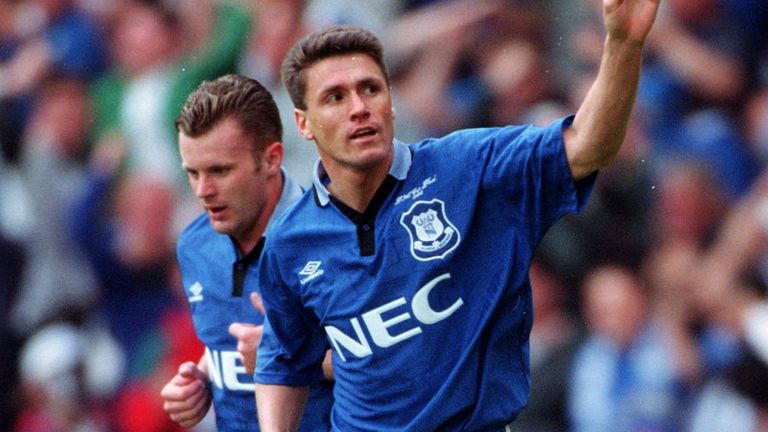
Paul Rideout Everton
On May 20, 1995, Paul Rideout etched his name into Everton’s history by scoring the decisive goal against Manchester United in the FA Cup final. This victory marked Everton’s last major trophy, a testament to Rideout’s impeccable technique and the team’s resilience during a challenging season.
Paul Rideout said: “One of my main assets was the timing of my headers. Whatever people say, that was a top header. I had to generate the power and I had only one side of the goal to put it in while reacting quickly under pressure from Denis Irwin. At the end of the day you time it right. It needed to go in one spot and it did. If you look at it I think Peter Schmeichel got caught out because I don’t think he expected it to go back into that corner. It was kind of a slow motion goal. It didn’t fly into the back of the net, it looped in somewhat strangely. Manchester United were so dominant around that time but that season they ended up with nothing and us, who had been fighting to stay up, ended up beating them in the FA Cup final and being more successful than them.”
Rideout’s goal was not only a personal triumph but also a critical moment for Everton, who had been battling relegation throughout the 1994/95 season. The team’s fortunes began to change when Joe Royle took over as manager, leading them to display top-six form for the remainder of the season. Rideout’s crucial goal against Ipswich Town in their penultimate fixture ensured Everton’s Premier League survival, highlighting the importance of his contributions beyond the FA Cup final.
Paul Rideout said: “That game was more intense than the FA Cup final because we only had one more game after that and we didn’t want to have to go through another game like we’d had against Wimbledon the year before. My goal at Portman Road was in many ways just as important as the one at Wembley because of what it meant for our Premier League status.”
The pressure of relegation battles seemed to have prepared Everton’s players for the FA Cup final, allowing them to approach the match with a sense of relief and focus. Joe Royle’s management style played a significant role in this mindset, as he encouraged the team to view the final as a bonus after securing their league status.
Paul Rideout said: “We’d been fighting against relegation all season and up until one week before the final, that had always been our main goal. In all honesty, none of our minds had been on the final and Joe Royle had said to us that it was just a bonus. It had been something of a relief just to stay in the Premier League and we were looking forward to the FA Cup final in a different way.”
Royle’s no-nonsense approach, coupled with Willie Donachie’s organizational skills, transformed Everton into a cohesive unit known as ‘The Dogs of War.’ The team was characterized by their hard work and intelligence, which Rideout credits for their success.
Paul Rideout said: “Joe’s man-management was fabulous. He’d been a forward himself and understood what it was like. I also put a lot of praise on Willie Donachie as well though, the way he came in and reorganised that group. We had what we had, and everyone knew their job. That was the difference between Joe and Willie and the previous manager who had no concept of how to put things right.”
Everton’s victory in the 1995 FA Cup final remains a cherished memory for Rideout and the club’s supporters, symbolizing a period of resilience and triumph against the odds.
About The Author